
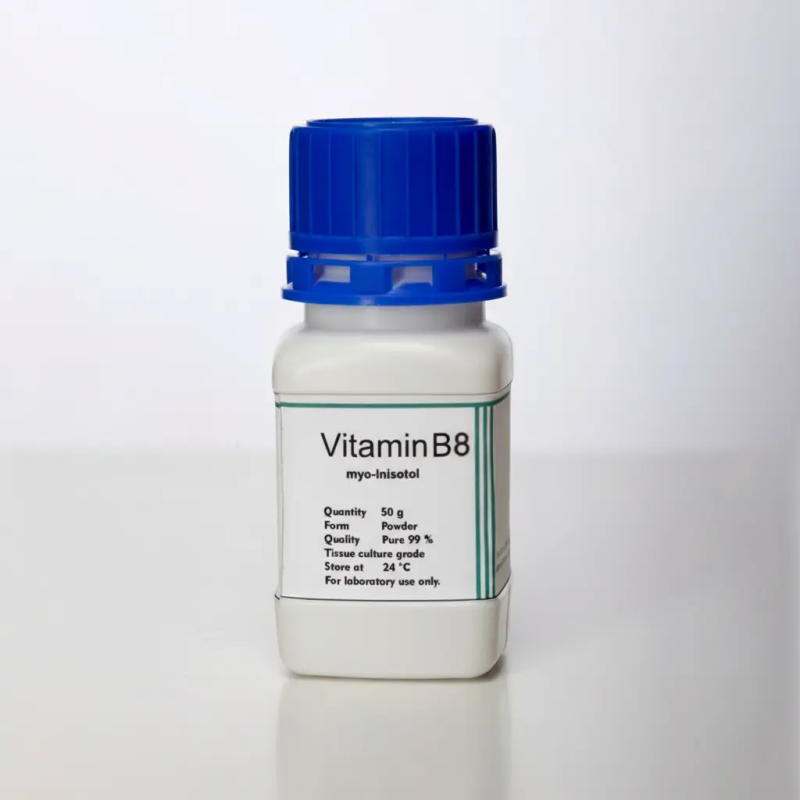

Other names: Myo-inositol, Inositol, Vitamin B8, 1,2,3,5-cis-4,6-cyclohexanehexol, Dambose
Chemical formula: C₆H₁₂O₆
CAS No.: 87-89-8
Purity: ≥ 99% active ingredient
Appearance: White powder
Shelf life: 2 years
Packaging options: 1 g, 3 g, 5 g, 10 g, 100 g (on request), 1 kg (on request)
 Security policy
Please review the Security Policy before placing your order.
 Delivery and return policy
Please review before placing your order.
 Requirements Related to the Purchase of Chemicals
Please review before placing your order.
Myo-inositol (Vitamin B8) is a vitamin-like compound and a structural isomer of glucose, classified as a six-carbon cyclitol. Although it shares a similar formula with carbohydrates, inositol is not a carbohydrate but a polyol — slightly sweet, tasteless, and biologically essential for plants.
Inositol plays a central role in plant hormone regulation, especially in the storage and transport of auxins. By forming auxin–inositol conjugates, it allows hormones to be stored and transported in an inactive state, preventing premature activity and enabling precise delivery to target tissues. Specific plant enzymes can both conjugate auxins with inositol and release them, ensuring finely tuned hormonal control.
Auxin Regulation: Ensures controlled transport and storage of auxins, preventing premature action and enabling precise growth responses.
Salt Stress Resistance: Inositol and its derivatives protect cellular structures from oxidative stress and help regulate osmotic pressure, enhancing tolerance to salinity. They also aid in sodium transport and distribution, contributing to salt-stress adaptation in plants.
Signal Transduction (PI Pathway): A crucial component of the phosphoinositide (PI) signaling pathway, which mediates plant responses to environmental stress, gravitropism (root downward growth), and stomatal pressure regulation.
Phosphate Storage in Seeds: Inositol forms inositol hexaphosphate (IP₆), a vital phosphate reserve in seeds. During germination, IP₆ is broken down into phosphate and inositol, supporting seedling growth and protein synthesis.
Cell Wall Biosynthesis: Oxidized inositol derivatives are key sugars in plant cell wall polysaccharide synthesis, contributing to structural integrity and supplying components for essential metabolic pathways.
Widely used in plant tissue culture media as a key vitamin and growth factor
Enhances hormone regulation, seed germination, and stress tolerance
Essential for cell wall formation, signal transduction, and nutrient storage
Improves overall plant growth, development, and biotechnological efficiency
Store the powder in a cool, dry, and dark place.
Use freshly prepared solutions to maintain maximum biological activity.
Other names: Myo-inositol, Inositol, Vitamin B8, 1,2,3,5-cis-4,6-cyclohexanehexol, Dambose
Chemical formula: C₆H₁₂O₆
CAS No.: 87-89-8
Purity: ≥ 99% active ingredient
Appearance: White powder
Shelf life: 2 years
Packaging options: 1 g, 3 g, 5 g, 10 g, 100 g (on request), 1 kg (on request)